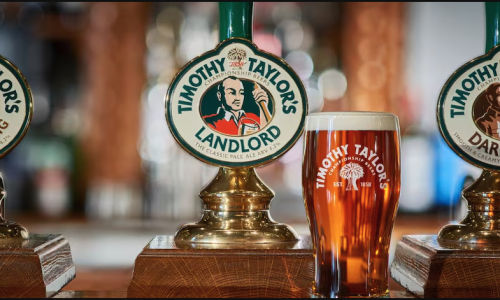
What’s in a name? It turns out it can have quite an impact, as even recently, someone I encountered seemed to recoil at the thought of the word “bitter”, but said they liked pale ales.
Further, authentic examples have begun rebranding such beers as "amber ales" (e.g. Spitfire Amber Ale), a term which meant something fairly different, historically.
The exchange sometimes seems to go something like:
"Oh, I don't like bitter beer"
"Oh, it's not actually that bitter"
Well, *puts on Morpheus shades*:
The Bitter Ale replaced Mild as the working class pub favorite in the 1960s, before being supplanted by lagers by the 1980s.
Here’s where it gets really confusing - “bitter” is a term that originated on the customer’s side of the bar, and bottled products are usually referred to as Pale Ales, draft products as Bitter.
A Brief British Beer Primer
For background, by the early 19th century, all British beer except Porter/Stout had gone pale. Decades earlier, brewers discovered the false economy of using cheaper, then fully self-converting, brown malt in brewing Porter. Additionally, pale beers were seen at the time as higher quality, since pale malt was originally very expensive, and used in brewing on wealthy, private estates. (Steele, Mitch. IPA Brewing Techniques, Recipes, and the Evolution of, p. 16)
In the old days, aged Porter was King and breweries had huge vats to age such beer - it was even a favorite of George Washingon. Reportedly there were 22 bottles of it (among many other drinks) at the party where they celebrated the U.S. Constitutional Convention (USA Today: Fact Check: George Washington's hefty bar tab...). Pale Ale (IPA) was an expensive, premium aged product. By the late 19th century, British brewing culture had changed. The vat-aged, Brettanomyces-kissed stock ales fell out of fashion just as science was finally able to explain the microbiology, and drinkers began preferring “running” beers, meaning beer ready to serve after a short time, longer than required for a “mild”, but shorter than the months required for a real stock ale.
Now, those of you who know British beer will see “mild” and think of a ~3.5% sweeter, almost indiscernible from a light brown ale. However, in order to understand the genesis of this family of beer styles and the term “bitter”, we’ll have to step back in time a bit.
Prior to around 1700, “beer” had hops, “ale” did not. They were two separate taxonomic malt liquor classifications, with two sets of tax laws pertaining to them. Ever since hops were introduced by Flemish immigrants to England in the 1500s a debate raged on about whether or not they were a proper ingredient for ale. Brewers made ales and beers using brown, amber, and pale malts. The strongest beers, using the most recently harvest grain and hops were “October beers”, seen as the ancestor of IPAs and Barleywines. The aged ones were called “stock” or “keeping” beers, the ones served young, shortly after fermentation was complete, were “milds”. (Pattinson, Ron: Shut Up About Barclay Perkins: A Short History of Mild)
The lines blurred around 1710 when Parliament legislated the use of hops in ale, at 1/4 the rate of equivalent beer, since the preservative qualities of hops were well-known by this time. A malt tax levied around the same time to pay for the War of Spanish Succession also incentivized brewing more “beers” that would keep longer than “ales”. (Pattinson, Ron. Shut Up About Barclay Perkins: Obadiah Poundage's Letter of 1760) By 1800 or so, the lines had blurred and “pale ale” could mean a beer. (Steele, p.18)
X Marks the Strong Ale
Unaged pale ales from the 18th century, served immediately after primary fermentation was complete, are the direct precursor to the modern Dark Mild.
Yes, you read that right, it sounds contradictory, but it’s well-documented. How? By taxation… This is one of those cases where government intervention comes in pretty handy.
Until 1830, the British tax system for beer involved marking the barrels with a “T” for Table beer, or “X” for Strong beer, but publicans were known to blend to stretch their reserves to get around the spirit of the law. It is purported that the X stands for the Roman numeral 10, for 10 shillings / barrel, which was the tax on strong beer when the law was abolished, but it has been suggested it could have stood for eXcise. I like the Roman numeral explanation, personally, but it's hard to know for sure.
These “X” ales were pale, strong ales, served relatively soon after they completed fermentation. Barclay Perkins X Ale serves as a wonderful example of this transformation, from a ~6.5% abv pale, hoppy strong ale in 1838, to a modern Dark Mild by WW2. Our homebrew club once experimented and brewed six different version of Barclay Perkins X Mild Ale over that span.
Breweries would brew equivalent “stock” beers with more hops, including dry hops in the hogshead, and these casks would be marked with a “K”, often at the end of the X’s, e.g. XX and XXK. (Pattinson, Ron. Shut Up About Barclay Perkins: Beer code)
A Bitter Divide
Towards the middle of the 19th century, “running” beers became more popular. The arrival of the British railway to Burton-upon-Trent in 1839 afforded many more domestic opportunities for the brewers there, and many of them started making lower ABV pale ales that were hoppier than the milds, but less hoppy than the aged IPAs for the domestic market. (Cornell, Martyn. Amber, Gold, & Black. p.14)
However, in the pub setting, there wasn’t a standardized, clear way for the patron to ask for this sort of beer. Today, pump clips would identify the beers, but those were still 80-100 years off, only becoming widespread by the 1950s. Recall, in this time, milds also were pale ales, and they were also the most popular beer in England to the working class, supplanting Porter in the 1830s.
Internally, brewers often called these beers “Pale Ale”, or by a shorthand designation within the prior X and K system, but bar patrons began referring to them as “bitter”, in order to differentiate from the less attenuated, relatively sweeter mild ale. (Cornell, Martyn. Amber, Gold, & Black. p.10)
Reinheitsgetbot by Taxation
British brewing went through its own sort of Reinheistgebot for a while. While there were some unfounded rumors of adulterants (strychnine) being used to make beer taste more bitter, it kind of came down to tax laws: In short, you were taxed on the amount of malt that you used, so the tax man did not want you using adjuncts.
Some allowanced were made at times for different brewing sugars, first a burnt sugar product called "essentia bina" to color Porters prior to the invention of the drum malt roaster and black patent malt, but even more notably in 1847: At the same time as the Irish Potato Famine, a barley shortage precipitated a law that allowed the use of sugars on which the “full duties had been paid.” Beer writer Martyn Cornell noted that there was pressure from West Indies sugar barons eager to expand their customer base as well.
Molasses and honey were notably excluded, as it carried a much lighter duty, in order to support colonial economies. Malt carried a heavy duty of 21s 8d per quarter (roughly 336 lbs) and the British government made big money off of it, so it had to make sure any substitute ingredients were similarly taxed. The adoption of sugars was relatively low during this period, in part because of increased scrutiny from use of sugars from excise officers, in part likely because many people saw all malt beers as superior. Adoption increased after a rise in the price of malt in 1866. (Cornell, Martyn. Porter and Stout A Complete History p.40)
"That if after the passing of this Act, any brewer shall make use of molasses, sugar, honey, syrup, or extract of sugar, except sugar on which the duty has been paid as aforesaid, and made use of in the manner hereinbefore allowed; or if any such person receives or takes into his custody or possession any quantity of molasses, honey, syrup, composition, or extract of sugar, every such brewer shallforfeit and lose for every such offence the sum of 200l."
Excerpt from: Brewing From Sugar Bill (1847): British Parliament
Then came one of my favorite pieces of legislation in history: The Free Mash Tun Act of 1880 (officially the Inland Revenue Act, but that's less fun). This changed it so brewers were taxed on their original gravity, given as a rate of a "standard barrel" at 1057 OG, later 1055 OG, rather than the amount of malt they used. It wiped out the use adjuncts as an advantage of private brewers since they could now get in on the action, and they did.
"The duty on beer brewed by a brewer for sale shall be charged in respect of every thirty-six gallons of worts produced of the gravity or original gravity of one thousand and fifty-seven degrees, and so in proportion for any difference in quantity or gravity as entered in the book by the brewer, or as ascertained by the officer, whichever is higher."
Excerpt from: Inland Revenue Act (1880): British Parliament
At first, rice was the preferred unmalted adjunct, but quickly maize became the preferred one. (Pattinson, Ron. Shut Up About Barclay Perkins: Lets Brew 1886 Barclay Perkins PA)
Lots of beers started using proprietary sugar syrups and invert sugars, which are made through the hydrolysis of sugar in the presence of an acid. These adjuncts helped bring beers into condition more quickly than ones made entirely from malt. (Steele. p. 59)
Is Your Bitter Running? You Better Go Drink It!
Around this time, another “beer code” entered the chat: AK, often referred to by brewing historian Ron Pattinson as the “classic running bitter”.
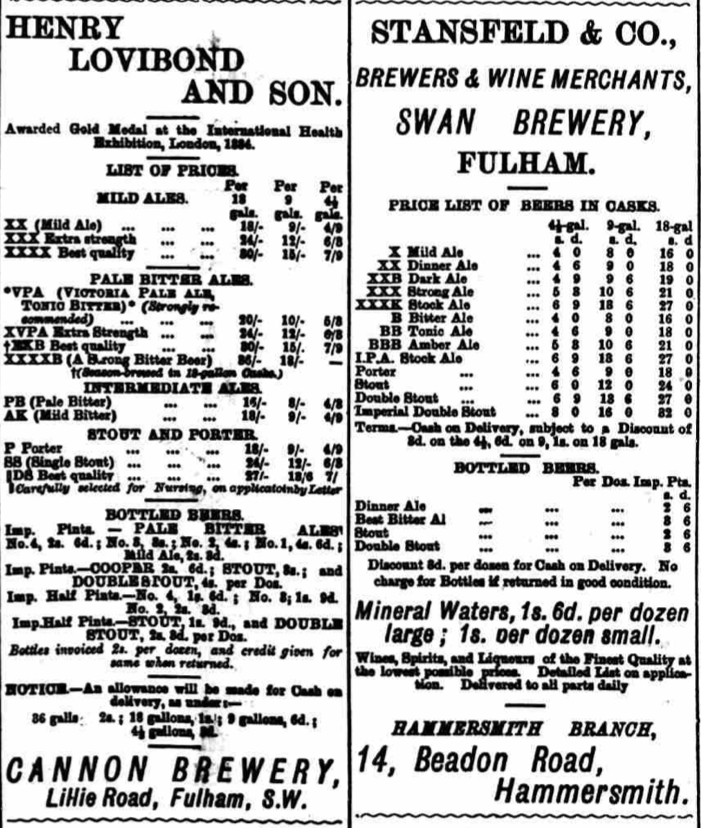
Ads for breweries illustrating beer codes in the West London Observer, Mar. 7, 1896
What exactly does “AK” mean? I’ve heard a lot of theories about it - possibly being related to a Dutch beer from hundreds of years prior, or named after a guy named Arthur King… The explanation that sticks with me the most, however, is that it is simply an extension of the X and K system introduced by the old tax laws.
In that system, “A” would indicate an ale one strength class below “X”, and “K” would indicate that it was hopped more and should be rested 2-4 weeks before being served, rather than several months that would be required for a real stock ale. (Pattinson, Ron. Shut up About Barclay Perkins: What Was AK?)
Although these “AK” beers were often 4.5-5%, they could be considered a precursor to the modern Ordinary and Best Bitter. It is worth noting that all British beer prior to WW1 was stronger, and from the recipes I would argue it was when British brewing was at its best. Often, but not always, AK was the weakest in the bitter lineup. In the case of the Charles Rose & Co Brewery, who produced the beer Light Day Away was based on, in 1896 the "B" Pale Ale was the weakest bitter. Then in ascending strength, there was the AK, then the much hoppier IPA, then another slightly stronger Pale Ale called "PA". (Pattinson, Ron. Shut Up About Barclay Perkins: Rose Beers in 1896)
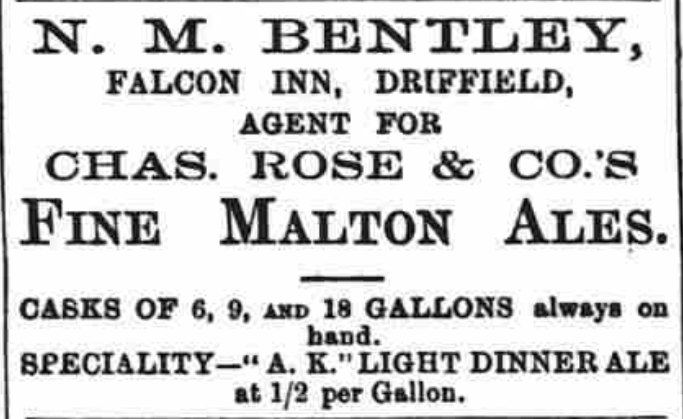
An ad from the Driffield Times and General Advertiser. Driffield, Yorkshire, England. Oct. 31, 1896 for the exact beer Light Day Away is based on: "AK" Light Dinner Ale. Originally 1 shilling 2 pence per gallon.
As the above ad shows, “AK” beers often were marketed towards private families, using terms like “Dinner Ale”, “Light Dinner Ale”, “Luncheon Ale”, some extra hoppy beers would be called “Tonic ale”, due to the perception at the time that bitter flavor was good for them. (Durden Park Beer Circle: Old British Beers and How to Make Them, p. 14)
These “AK” beers usually would be comprised of barley from all over the world (some of it 6 row) malted in England, large amounts of flaked rice or corn, and invert sugar syrups. For hops, they would sometimes use American hops for bittering, but would finish with Goldings, Saaz, or sometimes Hallertau, as was the case for the Charles Rose brewery in 1896. (Pattinson, Ron. Shut Up About Barclay Perkins: Lets Brew 1896 Rose AK)
Modern Bitter Family
The BJCP defines a set of three styles for English Bitters, for three different strength classifications: Ordinary, Best, and Strong. The last one, thanks to the influence of Fuller’s, has Americans also thinking the style generically is called “Extra Special Bitter”, but that’s a brand name. It seems to have been popularized by such American versions of these beers like Red Hook ESB (Source: BJCP Guidelines for 11C: Strong Bitter)
So what exactly happened to the “AK” as a beer style? Actually, one example still exists: McMullen’s AK.
Beyond that, AK suffered from the gravity restrictions during the World Wars that killed off some of the weaker beers in breweries’ lineups, including Porter. Many examples with that particular beer code were dropped, but several examples persisted into the 1980s. (Pattinson, Ron. AK! p.32)
As for the ingredients, Crystal malts, although available since the 1880s, became more common in bitters after WW2, probably in response to how weak the beers had become otherwise.
Although specific AK’s died off, the entire modern draft “bitter family” is its spiritual successor.
Cheers!